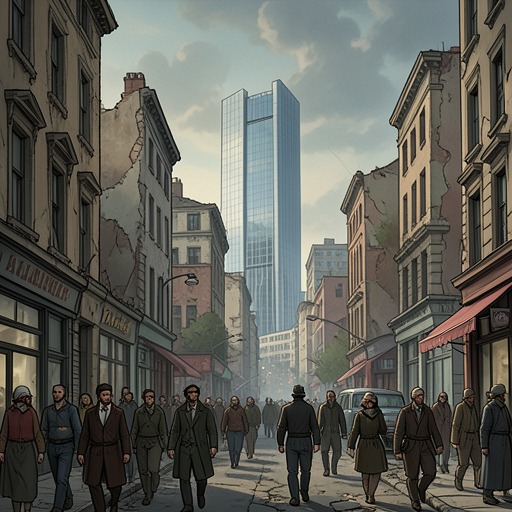
District of the Viceroys
Love in the Time of CholeraThe District of the Viceroys is the historic residential quarter of the city’s wealthy families, a place where colonial magnificence persists chiefly as memory and ruin. Its palaces and public spaces stage the contrast between an imagined golden age and the deteriorating city around them, while the district’s walls and customs expose the social boundaries governing everyday life.
Setting and Historical Memory
In the eighteenth century, the city prospered as the Caribbean’s leading commercial center, built in large measure on its status as the largest African slave market in the Americas. It was also the permanent residence of the Viceroys of the New Kingdom of Granada. Fleets carrying the treasures of Potosí, Quito, and Veracruz gathered in its bay, and the city’s years of glory became a powerful inheritance in local memory.
That inheritance is shadowed by catastrophe. On June 8, 1708, the galleon San José sailed for Cádiz with precious stones and metals valued at five hundred billion pesos in the currency of the day. An English squadron sank it at the harbor entrance; two centuries later, the wreck had not been salvaged. Historians invoked the treasure beneath the coral, and the commander’s body floating on the bridge, as an emblem of a city itself drowned in memories.
The quarter’s decay makes that history tangible. After independence from Spain and the abolition of slavery, the old families withdrew into ruined palaces. Weeds hung from balconies, cracks opened in the whitewashed walls, and languid piano exercises were among the few signs of life in the afternoon streets. At nightfall, mosquitoes rose from the swamps, while the open sewers made the city’s atmosphere an intimate reminder of mortality.
Aristocratic Space and Social Boundaries
The district’s old wealth shaped not only its buildings but also the rules governing its inhabitants. At the beaches near the lighthouse, a plaster wall divided the women’s bathing place from the men’s. Society ladies appeared in ruffled bathing suits, slippers, and hats that concealed much of their bodies; their mothers watched from wicker rocking chairs, dressed as they were at High Mass, anxious that men from the neighboring beach might seduce their daughters under water. The division turned leisure into a guarded performance of respectability.
That performance could be watched for a small fee. The lighthouse keeper installed a spyglass through which customers could view the women’s beach for a centavo. The spectacle offered little beyond the street’s ordinary restrictions, yet its forbidden quality drew a Sunday crowd. Florentino Ariza visited, more from boredom than pleasure. The episode makes the district’s social boundaries literal: desire is permitted a narrow view, but not an unguarded crossing.
The quarter’s prestige also depended on the habits and appearances of its upper class. When Fermina Daza and Hildebranda Sánchez emerged from a photographer’s studio with faces powdered white with starch and lips painted chocolate-colored, their dress seemed inappropriate to the hour and their age. A crowd mocked and cornered them in the plaza; the arrival of a landau drawn by golden chestnuts opened a way through the hostile gathering. The carriage’s authority abruptly silenced the catcalls, showing how conspicuous status could still command public space.
Ruined Palaces and Changing Inhabitants
The former palace of the Marquis de Casalduero, historic residence of the Urbino de la Calle family, registers the quarter’s decline in its architecture. When Juvenal Urbino returned from Europe, he found a dusty fountain, brambles in the flower beds, iguanas in the garden, and missing or broken marble slabs on the great staircase. His father had died in the Asian cholera epidemic six years earlier, and with him, the spirit of the house had disappeared. Doña Blanca’s mourning had replaced the family’s lyrical soirées and chamber concerts with evening novenas; Juvenal’s sisters were destined for the convent.
His first night back turned the mansion into a space of dread rather than refuge. He lay awake amid darkness and silence, disturbed by the cries of women from the neighboring Divine Shepherdess Asylum, the drip of water into a basin, and a curlew wandering through his bedroom. Fear of the dark and the imagined presence of his dead father made the vast house feel less like a monument to family standing than a repository of bereavement. In time, family affection, country Sundays, and the attentions of unmarried women helped him accept the city and its habits.
The district did not stand apart from the wider crisis of urban life. Juvenal’s concern with sanitation reached beyond its grand houses: he pressed the authorities to replace open Spanish sewers, urged latrine construction in poor settlements, and opposed dumping garbage in the mangroves. The quarter’s well-equipped houses might possess septic tanks, but two thirds of the population lived in shanties at the swamp’s edge. Its privileged architecture therefore existed beside, and depended on ignoring, a citywide public-health emergency.
A Landscape Recast by Time
From above, the old city appeared both beautiful and abandoned. During a balloon flight, Fermina Daza and Juvenal Urbino saw Cartagena de Indias with its walls still intact, brambles in the streets, fortifications overgrown with heartsease, and palaces and altars left to rot. The city had been deserted during cholera panic after centuries of resisting English sieges and buccaneer violence. Seen from the sky, its defenses remained, but the society they had protected had vanished.
The District of the Viceroys thus joins personal memory to collective history. Its ruins embody a lost colonial order, while its surviving boundaries preserve the old distinctions of class and gender. Yet neither wealth nor custom can arrest change: disease empties the city, family houses lose their inhabitants and rituals, and inherited grandeur becomes an image held against present decay.